

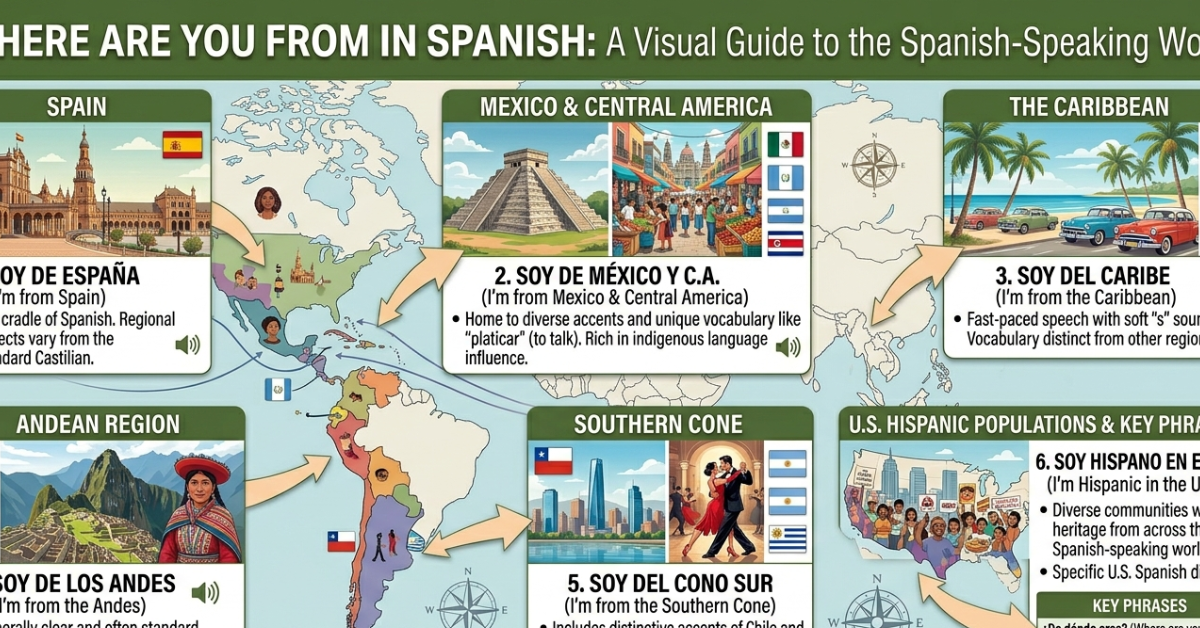

If you’ve ever started learning Spanish, one of the first questions you’ll want to ask is “where are you from in Spanish.” It’s a simple phrase, but it opens the door to real conversations, cultural exchange, and meaningful connections. Whether you’re chatting with a friend, meeting someone new, or practicing on an app, knowing how to ask this question correctly is essential.
In this guide, you’ll learn how to say where are you from in Spanish, when to use formal vs. informal versions, and how to respond naturally. Let’s break it down in a way that actually sticks.
How to Say “Where Are You From” in Spanish
The most common way to ask where are you from in Spanish is:
- ¿De dónde eres? (informal)
- ¿De dónde es usted? (formal)
Both phrases literally mean “From where are you?” and are widely used in Spanish-speaking countries.
Pronunciation Tips
- ¿De dónde eres? → deh DON-deh EH-res
- ¿De dónde es usted? → deh DON-deh es oos-TEHD
Don’t stress about perfection—clear communication matters more than accent.
Formal vs. Informal Usage
Understanding where are you from in Spanish formal and informal contexts is key.
Informal (Casual Situations)
Use ¿De dónde eres? when speaking to:
- Friends
- People your age
- Children
- Anyone in a relaxed setting
Formal (Respectful Situations)
Use ¿De dónde es usted? when speaking to:
- Elders
- Strangers
- Professionals (teachers, bosses)
If you’re unsure, it’s always safer to start formal.
Variations and Related Phrases
There are a few ways to express the same idea depending on context.
- ¿De qué país eres? – Which country are you from?
- ¿Cuál es tu origen? – What is your origin?
- ¿De dónde vienes? – Where do you come from?
These variations help expand your conversational skills beyond just one phrase.
How to Ask “Where Are You From” in Spanish Naturally
If you’re wondering how do you ask where are you from in Spanish in real conversations, context matters.
Here’s a simple conversation example:
- Tú: Hola, ¿cómo te llamas?
- Ellos: Me llamo Carlos.
- Tú: Mucho gusto. ¿De dónde eres?
Adding a greeting before the question makes it sound more natural and polite.
How to Respond to “Where Are You From” in Spanish
Knowing how to respond to where are you from in Spanish is just as important.
Common Answers:
- Soy de España. – I’m from Spain.
- Soy de México. – I’m from Mexico.
- Soy de Pakistán. – I’m from Pakistan.
More Detailed Responses:
- Soy de Lahore, pero vivo en Karachi.
- Nací en Madrid. – I was born in Madrid.
This is how you can confidently handle how to answer where are you from in Spanish in different situations.
Special Context Examples
Speaking to a Girl
If you’re asking where are you from in Spanish to a girl, the phrase stays the same:
- ¿De dónde eres?
Spanish doesn’t change this question based on gender.
Group Situations
If you’re asking multiple people (like “Pedro and Juan”), say:
- ¿De dónde son?
This answers questions like pedro and juan where are you from in Spanish.
Learning Apps Context
If you’ve seen this phrase in apps, where are you from in Spanish Duolingo usually teaches:
- ¿De dónde eres?
It’s the most beginner-friendly version.
Common Mistakes to Avoid
When learning how do you say where are you from in Spanish, watch out for these:
- Saying ¿Dónde eres? (incorrect)
- Forgetting “de” (essential for meaning)
- Using formal tone with close friends
Stick with the correct structure:
- ¿De dónde eres?
Why This Phrase Matters
Learning where are you from in Spanish language conversations is more than grammar—it’s about connection.
It helps you:
- Start conversations easily
- Learn about cultures
- Build friendships
- Practice real-life Spanish
This simple question is often the beginning of deeper dialogue.
FAQs
What is “where are you from in Spanish”?
It is most commonly translated as ¿De dónde eres? for informal use and ¿De dónde es usted? for formal situations.
How do I say “where are you from in Spanish” politely?
Use ¿De dónde es usted? to show respect, especially in formal settings.
How do you ask “where are you from in Spanish” to multiple people?
You would say ¿De dónde son?
How do you respond to this question?
You can answer with Soy de [place], such as Soy de México.
Is there a difference between formal and informal Spanish here?
Yes. Informal uses “eres,” while formal uses “es usted.”
Conclusion
Mastering where are you from in Spanish is one of the easiest and most useful steps in learning the language. With just a few variations—formal, informal, and plural—you can confidently start conversations anywhere.
The key takeaway?
- Use ¿De dónde eres? for casual situations
- Use ¿De dónde es usted? for formal ones
Now that you know how to say where are you from in Spanish and respond naturally, try using it in your next conversation. The more you practice, the more natural it will feel.