

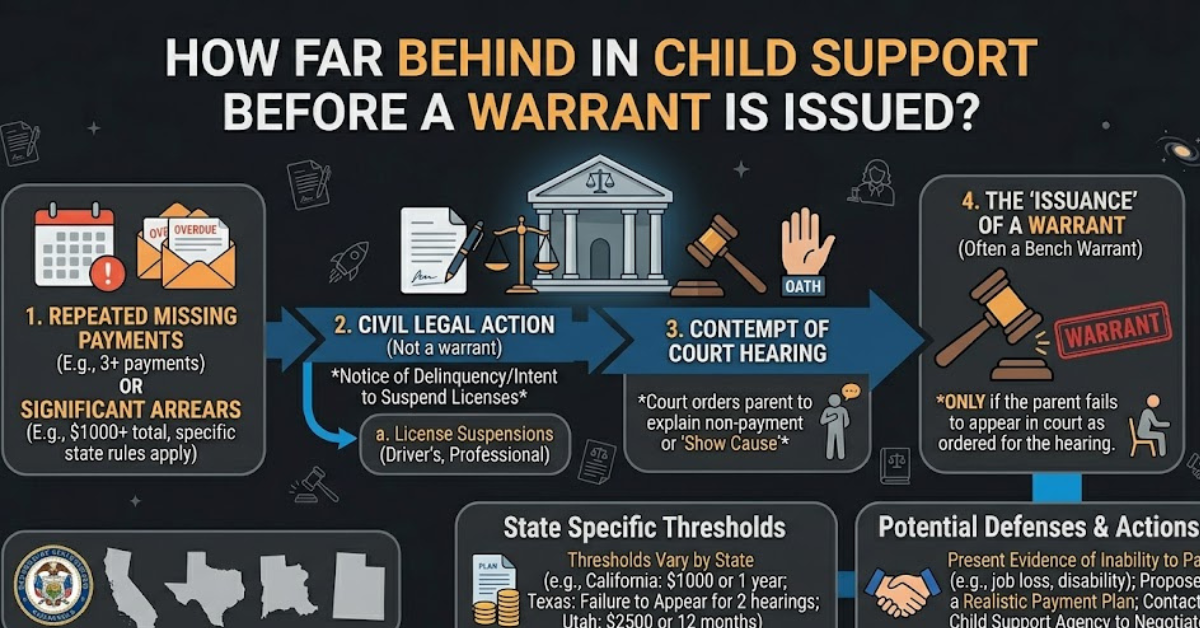

Missing a child support payment can feel overwhelming—but what happens if you fall too far behind? Many parents worry about how far behind in child support before a warrant is issued, and the answer isn’t as simple as a single number. Laws vary by location, but there are clear patterns in how courts handle missed payments. In this guide, we’ll break down timelines, legal triggers, and what you can do to stay on the right side of the law.
How Far Behind in Child Support Before a Warrant Is Issued?
There’s no universal rule that says a warrant is issued after a specific number of missed payments. However, in many jurisdictions, serious enforcement actions can begin when:
- You are 2–3 months behind, or
- Your unpaid balance (arrears) reaches a significant amount (often $1,000 or more)
A warrant is typically not the first step. Courts usually try other enforcement methods before escalating to an arrest warrant.
What Triggers a Child Support Warrant?
Before a warrant is issued, several legal steps usually occur. These are designed to give the paying parent opportunities to comply.
Common Triggers Include:
- Failure to appear in court after being summoned
- Ignoring payment orders despite warnings
- Accumulating substantial overdue child support (arrears)
- Violating a court-approved payment plan
In many cases, a judge must determine that the non-payment is willful—meaning you had the ability to pay but chose not to.
Typical Enforcement Timeline
While timelines differ, here’s a general progression of how enforcement can escalate:
- Missed Payments Begin
You fall behind by one or two payments. - Notice of Delinquency
The child support agency contacts you with warnings. - Administrative Actions
These may include:- Wage garnishment
- Tax refund interception
- License suspension (driver’s, professional)
- Court Hearing
You may be ordered to appear before a judge. - Contempt of Court
If you fail to comply, the court may hold you in contempt. - Warrant Issued
A bench warrant can be issued for your arrest.
Civil vs. Criminal Consequences
Understanding the difference matters when asking how far behind in child support before a warrant is issued.
Civil Enforcement
- Focuses on collecting unpaid support
- May involve fines or payment plans
- Jail time is possible but usually avoidable
Criminal Enforcement
- Applies in severe cases (large arrears or long-term neglect)
- Can lead to felony charges in some countries
- Warrants are more likely in these situations
How to Avoid a Warrant
If you’re struggling financially, ignoring the problem makes things worse. Here’s what you can do instead:
Take Action Early:
- Contact the child support agency immediately
- Request a modification of your payment order
- Show proof of income loss or hardship
Stay Engaged:
- Attend all court hearings
- Make partial payments if full payment isn’t possible
- Keep records of all communication and payments
Courts are generally more lenient when they see effort and honesty.
Factors That Affect When a Warrant Is Issued
Several variables influence how quickly enforcement escalates:
- Local laws and regulations
- Amount of overdue payments
- Length of time you’ve been behind
- Your payment history
- Whether you’ve responded to court notices
Because of these differences, two people in different regions could face very different outcomes.
FAQs
How many missed payments before a warrant is issued?
There’s no fixed number, but enforcement often escalates after 2–3 missed payments or significant arrears.
Can you go to jail for unpaid child support?
Yes, but usually only after a court finds you in contempt for willful non-payment.
What happens if I ignore a court summons?
Failing to appear in court is one of the fastest ways to trigger a bench warrant.
Can I stop a warrant from being issued?
Yes, by contacting the court, making payments, or requesting a modification before enforcement escalates.
Does partial payment help?
Absolutely. Even partial payments show good faith and can delay or prevent stricter penalties.
Conclusion
So, how far behind in child support before a warrant is issued? While there’s no universal cutoff, falling several months behind or ignoring court orders can quickly lead to serious consequences. The key takeaway is simple: act early, stay responsive, and communicate openly with the court or agency.
If you’re currently behind, don’t wait for enforcement to escalate. Take steps today to manage your situation and protect yourself from legal trouble.