

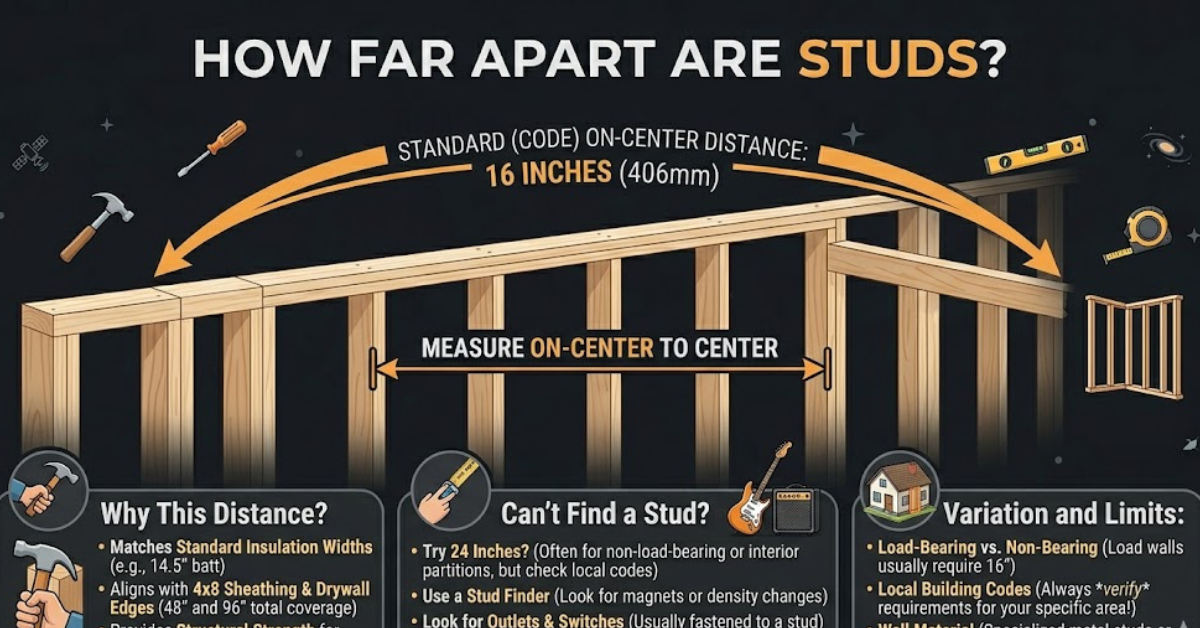

Ever tried to hang a shelf or mount a TV and wondered how far apart are studs behind your wall? You’re not alone. Understanding stud spacing is one of the most useful bits of knowledge for homeowners and DIY enthusiasts alike. In this guide, we’ll break down standard measurements, explain why spacing varies, and show you how to locate studs with confidence.
How Far Apart Are Studs in a Wall?
In most modern construction, the standard answer is:
- 16 inches apart (on center)
This means the center of one stud to the center of the next stud is 16 inches. This is the most common spacing used in residential buildings.
However, studs can also be spaced:
- 24 inches apart (on center) – often used in newer or energy-efficient homes
- 12 inches apart (on center) – less common, but used for extra structural strength
So when asking how far apart are studs in a wall, 16 inches is your safest assumption.
What Does “On Center” Mean?
This term confuses a lot of people at first.
- “On center” (OC) means measuring from the middle of one stud to the middle of the next
- The actual gap between edges is slightly smaller (since studs are typically 1.5 inches wide)
Understanding this helps when measuring or using a stud finder.
Why Stud Spacing Matters
Knowing how far apart studs are usually isn’t just trivia—it’s practical.
Here’s why it matters:
- Mounting heavy items (TVs, shelves, cabinets)
- Installing drywall or paneling
- Ensuring structural support
- Planning renovations or drilling safely
Missing a stud can mean weak support—or worse, damaging your wall.
How Far Apart Are Studs in Different Types of Homes?
Stud spacing can vary depending on the age and type of construction.
Modern Houses
- Typically 16 or 24 inches OC
- Built to standardized building codes
Old Houses
- Spacing may be irregular
- Could range from 12 to 24 inches
- Hand-built framing often leads to inconsistency
Apartments
- Usually follow modern standards (16 inches OC)
- May include metal studs instead of wood
Mobile Homes
- Often use 16 or 24 inches spacing
- Lightweight construction may affect layout
Garages
- Commonly 16 inches OC, but sometimes wider for cost efficiency
So if you’re asking how far apart are studs in a house, the answer depends on when and how it was built.
How to Find Studs in Your Wall
If you’re unsure about stud spacing, here are some easy ways to locate them:
1. Use a Stud Finder
- The quickest and most accurate method
- Works through drywall to detect framing
2. Measure from a Corner
- Start at a corner and measure 16 inches out
- Continue in 16-inch increments
3. Tap the Wall
- Hollow sound = no stud
- Solid sound = likely a stud
4. Look for Clues
- Electrical outlets are usually attached to studs
- Light switches can also help you locate framing
How Far Apart Are Studs in Ceilings?
Ceiling joists (similar to wall studs) are typically spaced:
- 16 inches OC or
- 24 inches OC
This is important when installing ceiling fans or hanging heavy fixtures.
When Stud Spacing Isn’t Standard
Not all walls follow the rules. You might encounter:
- Renovated walls with altered framing
- Load-bearing walls with tighter spacing
- Custom builds with unique layouts
That’s why it’s always smart to double-check before drilling.
FAQs
How far apart are studs typically?
Most studs are spaced 16 inches on center, though 24 inches is also common.
How far apart are studs in old houses?
They can be uneven, often ranging from 12 to 24 inches, depending on construction methods.
How far apart are studs in apartments?
Usually 16 inches OC, but metal studs are often used instead of wood.
How far apart are studs in ceilings?
Ceiling joists are typically 16 or 24 inches apart.
How far apart are studs supposed to be?
Building codes generally recommend 16 inches OC for standard walls.
Conclusion
So, how far apart are studs? In most cases, you’ll find them spaced 16 inches on center, with some variations depending on the building type and age. Knowing this simple detail can make a huge difference when tackling home projects, from mounting a TV to remodeling a room.
Before your next DIY job, take a moment to locate your studs properly—it’s a small step that ensures safety, stability, and a job well done.